 vibgg
Guides · 5 min read
Why is the funding rate 0.01%? The default rate explained
Most perpetual contracts sit at exactly 0.01% per 8 hours. Where that default comes from, why 4-hour contracts show 0.005%, and how many contracts sit there today.
·
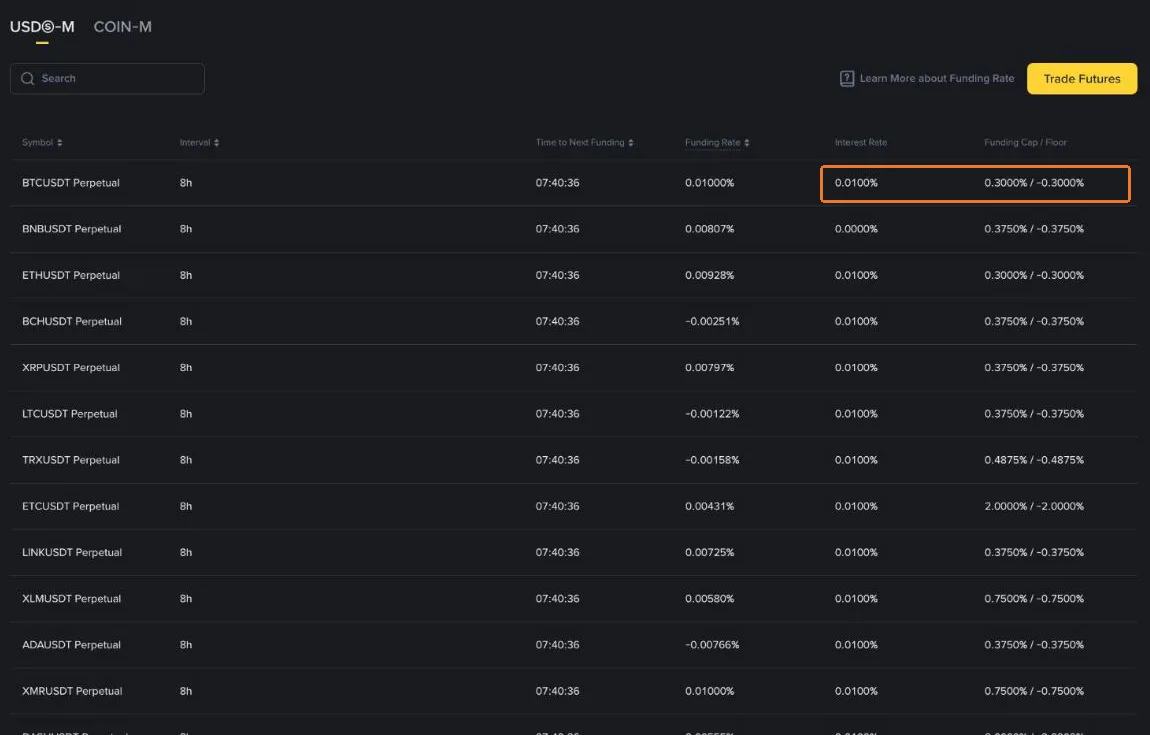
A funding rate of exactly 0.0100% every eight hours is not a placeholder or a coincidence. It is what the funding formula produces when a perpetual trades close to its index price: the interest component on its own, 0.03% a day. Binance, Bybit and OKX all publish the formula that leads there, and it is why so many contracts show the same number at once.
Right now 1,788 of the 3,764 perpetual contracts on vibgg's five exchanges sit exactly at that default. The rest are above it, below it, at zero or negative, and the table further down shows the split for each exchange.
Where the 0.01% comes from
The exchanges describe funding as two parts: an interest rate, fixed at 0.01% per eight hours (0.03% a day), and a premium index that measures how far the perpetual is trading above or below its index price. For an eight-hour contract the formula is:
funding rate = premium + clamp(interest − premium, −0.05%, +0.05%)
Here premium is the average premium index over the funding period, and clamp limits the second term to between −0.05% and +0.05%. Each exchange then caps the final rate at a maximum and minimum that depend on the contract.
Why the rate lands on exactly 0.01%
When the premium is small, the clamp does not bite, and the formula cancels out: premium + (0.01% − premium) = 0.01%. The premium drops out completely. That happens whenever the average premium is anywhere between −0.04% and +0.06% per eight hours, which at any moment is true for a large share of contracts.
| Average premium | Interest − premium | After the clamp | Funding rate |
|---|---|---|---|
| +0.0200% | −0.0100% | −0.0100% | +0.0100% |
| −0.0300% | +0.0400% | +0.0400% | +0.0100% |
| +0.0900% | −0.0800% | −0.0500% | +0.0400% |
| −0.0800% | +0.0900% | +0.0500% | −0.0300% |
The first two rows are inside the band, so both settle at the default even though the perpetual traded at a premium in one and at a discount in the other. Only the last two, where the premium is outside the band, move the rate away from 0.01%.
Why a 4-hour contract shows 0.005%
The interest component is a daily amount, 0.03%, split across however many settlements the contract has. Binance and OKX divide the whole result by 8 ÷ N, where N is the interval in hours; Bybit sets the interest rate to 0.03% ÷ (24 ÷ interval). Either way the default per settlement shrinks as settlements get more frequent:
| Interval | Default per settlement | Settlements a day | Per day | Per year (simple) |
|---|---|---|---|---|
| 8 hours | 0.0100% | 3 | 0.03% | 10.95% |
| 4 hours | 0.0050% | 6 | 0.03% | 10.95% |
| 2 hours | 0.0025% | 12 | 0.03% | 10.95% |
| 1 hour | 0.00125% | 24 | 0.03% | 10.95% |
So 0.0050% on a four-hour contract and 0.0100% on an eight-hour contract cost the same per day. Comparing the two raw numbers suggests one is half the price of the other, which is wrong. The guide to settlement times covers how intervals differ by exchange.
How many contracts sit at the default right now
“At the default” here means exactly 0.03% a day: 0.0100% on an eight-hour contract, 0.0050% on a four-hour one. “Below” means positive but lower than that.
| Exchange | At the default | Above | Below | Zero | Negative | Share at default |
|---|---|---|---|---|---|---|
| Binance | 353 | 42 | 88 | 3 | 81 | 62% |
| OKX | 194 | 48 | 45 | 152 | 60 | 39% |
| Bybit | 409 | 67 | 23 | 217 | 88 | 51% |
| Bitget | 389 | 58 | 53 | 289 | 56 | 46% |
| Gate | 443 | 46 | 33 | 432 | 95 | 42% |
The counts use each exchange's next funding rate and update with the live data. The formula above is the one Binance, Bybit and OKX publish; the table shows that Bitget and Gate contracts cluster at the same 0.03% a day.
Some contracts settle at exactly zero. Exchanges set the interest component to zero for certain pairs: Binance names ETHBTC, and Bybit names USDCUSDT and ETHBTCUSDT. On vibgg the zero group also includes several contracts that track stocks and commodities rather than crypto.
What the default costs you
A contract sitting at the default is not free to hold. A long pays the shorts 0.03% of the position value every day: $3 a day on a $10,000 position, about $90 over 30 days, and 10.95% a year before any trading fees. A short receives the same amount. Leverage does not change the dollar figure, because funding is charged on the position value, not on your margin.
The funding fee calculator works this out for any contract, size and holding period, using today's rate and the 30-day average on every exchange.
When the rate moves away from 0.01%
The rate leaves the default when the premium leaves the band. If buyers pay up for perpetuals until the average premium is above about +0.06% per eight hours, funding rises above 0.01% and longs pay more. If sellers push the perpetual below its index by more than about 0.04%, funding falls below 0.01% and can turn negative, so shorts pay longs.
That is why the default is a useful reference point when reading a funding rate table: a contract well above 0.01% has crowded longs, and one below it has more pressure from shorts. The funding rate rankings list the contracts furthest from the default on either side.
Does 0.01% mean the market is calm?
Not quite. It means the average premium over the funding period stayed inside a fairly wide band. A perpetual can swing between a premium and a discount within that band and still settle at exactly 0.01%. The default says little about where the price is heading; it only says neither side has been paying up for long enough to move funding.
It also does not mean every contract costs 10.95% a year to hold. Even large contracts spend much of their time below the default. The guide to funding rate history shows BTC's actual 7, 30 and 90-day averages on each exchange.