 vibgg
vibgg
Guides · 6 min read
Which exchange has the lowest fees for perpetual futures?
Today's standard maker and taker fees on Binance, OKX, Bybit, Bitget and Gate, and how to find the cheapest exchange for your volume and holding time.
·
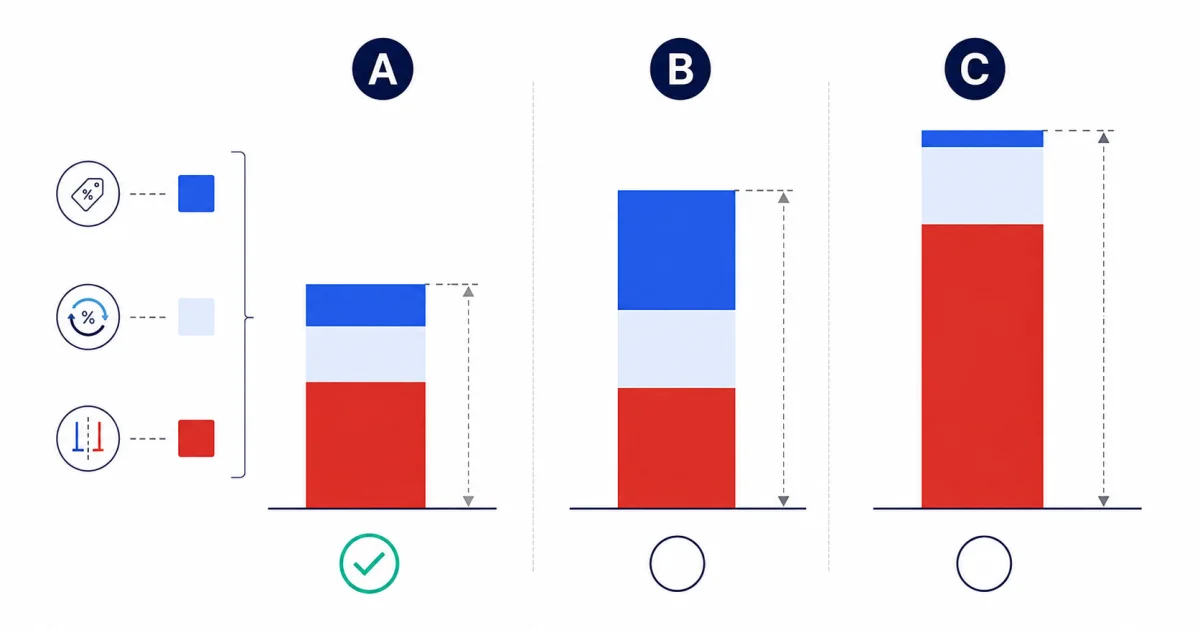
No exchange is cheapest for every trader. Someone who trades 90% with market orders and someone who holds a position for three weeks can get opposite answers, because trading fees, funding and spread carry different weight in each case. This guide starts with today's standard fees, then shows how to work out which exchange is cheapest for the way you trade.
Standard futures fees on each exchange today
These are the standard VIP 0 maker and taker fees for USDT-margined perpetual futures, taken from each exchange's official fee page and sorted from the lowest taker fee. The table updates whenever a fee level is re-checked.
| Exchange | Maker (VIP 0) | Taker (VIP 0) |
|---|---|---|
| Binance | 0.02% | 0.05% |
| OKX | 0.02% | 0.05% |
| Gate | 0.02% | 0.05% |
| Bybit | 0.02% | 0.055% |
| Bitget | 0.02% | 0.06% |
At the entry level the gap between exchanges is small: maker fees sit around 0.02% and taker fees between 0.05% and 0.06%. On $1,000,000 of monthly volume, a 0.01% difference in the taker fee is $100 a month. The differences that usually move your total cost more are funding, your VIP level and how often you use market orders.
Compare the complete cost, not only the fee rate
A maker/taker table shows the exchange's trading commission. Funding and execution costs can change the total, and which one is largest depends on the trade.
The total cost of trading a perpetual contract is:
estimated cost = trading fees − eligible rebate
               + funding paid − funding received
               + estimated spread cost
A position closed before a funding settlement normally pays no funding for that period. Holding through many settlements can make funding larger than trading fees, depending on the rate, the settlement interval, your direction and how long you hold. vibgg's cost calculator adds half the quoted bid-ask spread on market-order volume; it does not model slippage on large orders, borrowing or transfer costs. See how spread and slippage add to trading cost.
Check the fee schedule that applies to your account
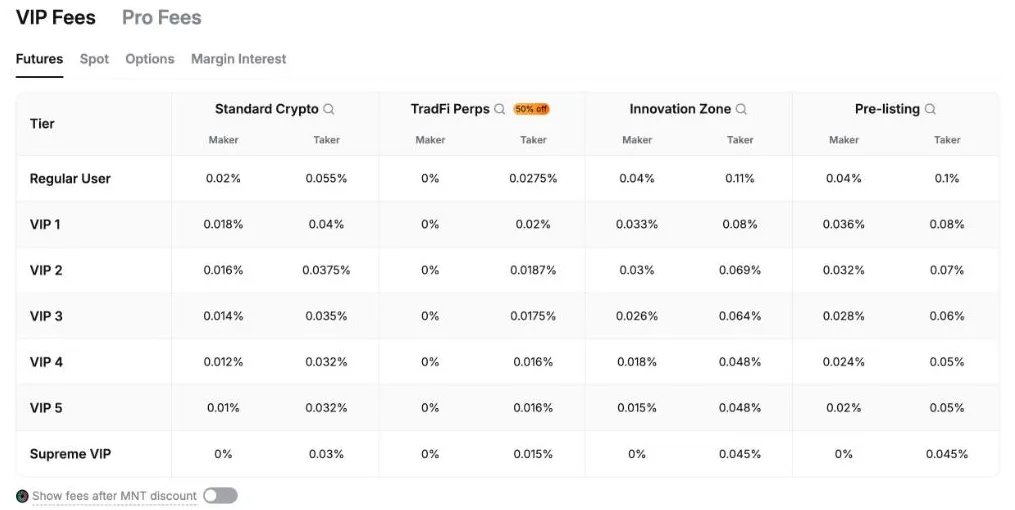
As one example, Bybit's standard VIP 0 perpetual and futures fee table listed 0.0200% maker and 0.0550% taker when reviewed on 27 September 2026. The same page notes regional differences and separate product categories, so the headline table is not a promise about every account. Because you pay a fee on every entry and every exit, even a difference of 0.001% adds up at high volume.
The differences that matter most show up elsewhere:
- Funding. Each exchange sets its own funding rate from its own market. The same contract at the same moment can have a very different rate on two exchanges, and occasionally the opposite sign.
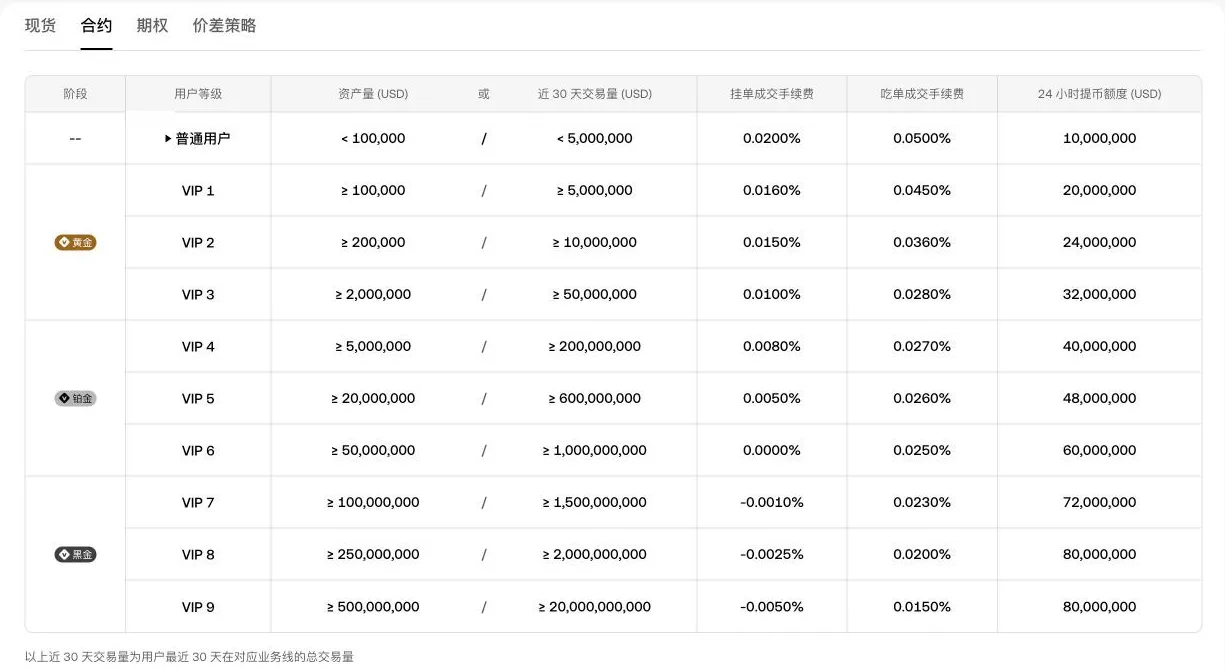
- VIP level. Compare the level your account actually qualifies for, including each exchange's volume, asset and product rules. The same VIP number does not mean the same price on two exchanges.
- Rebates and discounts. Count a referral or promotional discount only after confirming that your account, region and product qualify under the current terms.
- Spread. Check the price you can actually trade at for your order size. A narrow best bid and ask does not guarantee that a large order fills at that price.
How to work out your own answer
Start with three numbers, then check the contract, direction and account terms:
- Monthly trading volume. Count both opening and closing trades, the same way exchanges count volume for VIP levels.
- Your taker share. The part of your volume charged the taker fee. A limit order that matches immediately also pays the taker fee, so check your trade history rather than assuming only market orders are taker.
- Average holding time. Check which funding settlements the position crosses. Even a short trade can straddle a settlement, and holding for days adds more of them.
Enter these in the futures trading cost calculator to compare yearly costs on every exchange. Try different holding times, and compare with the referral discount switched off as well. The results assume today's funding rates and prices stay the same, so read them as a comparison, not a forecast.
Three trading styles, three different answers
The day trader. High volume, mostly market orders, positions measured in minutes or hours. If no funding settlement is crossed, trading fees and execution prices matter far more than funding. Higher volume may also qualify for a lower VIP fee level.
The swing trader. Moderate volume, a mix of maker and taker orders, positions held for days. Funding becomes a real part of the cost, and the cheapest exchange depends on the contract, your direction and the rates over the holding period, which can change at every settlement.
The funding-rate arbitrage trader. Holds offsetting positions to collect funding. Fees, spread, slippage and financing costs on both legs all come out of the income, and basis and liquidation risk remain. A high displayed rate on its own does not mean a positive net return; see the risks of funding rate arbitrage.
The mistake worth avoiding
One cost you control directly is whether an order has to fill immediately or can wait in the order book as a maker order. Weigh the fee difference against the chance that a limit order never fills, or fills just before the price moves against you.
Example with round numbers: assume a 0.02% maker fee, a 0.05% taker fee and $100,000 of total volume, counting both opening and closing trades. At 80% taker, the blended rate is 0.8 × 0.05% + 0.2 × 0.02% = 0.044%, which costs $44. At 50% taker it is 0.035%, which costs $35. The $9 difference is about 20% of the first fee bill, before any funding, spread or rebate.
Use your own numbers to decide what matters most: check funding before a settlement, confirm the fee level and discounts that apply to your account, then compare the prices you can actually trade at for your order size.
Every exchange's full VIP fee schedule is on the futures fee comparison pages, with side-by-side comparisons of any two exchanges.
Sources
The fees quoted in this guide were checked against the official sources below on 27 September 2026, and the table at the top updates whenever a fee level is re-checked. The $44 and $35 figures are a worked example, not a trading result. VIP, regional and promotional pricing can differ by account, so check the fee shown in your own account before trading.