 vibgg
vibgg
Guides · 4 min read
How to calculate a crypto funding fee in dollars
Turn a funding-rate percentage into the amount a long or short position will actually pay or receive, including different settlement intervals and leverage.
·
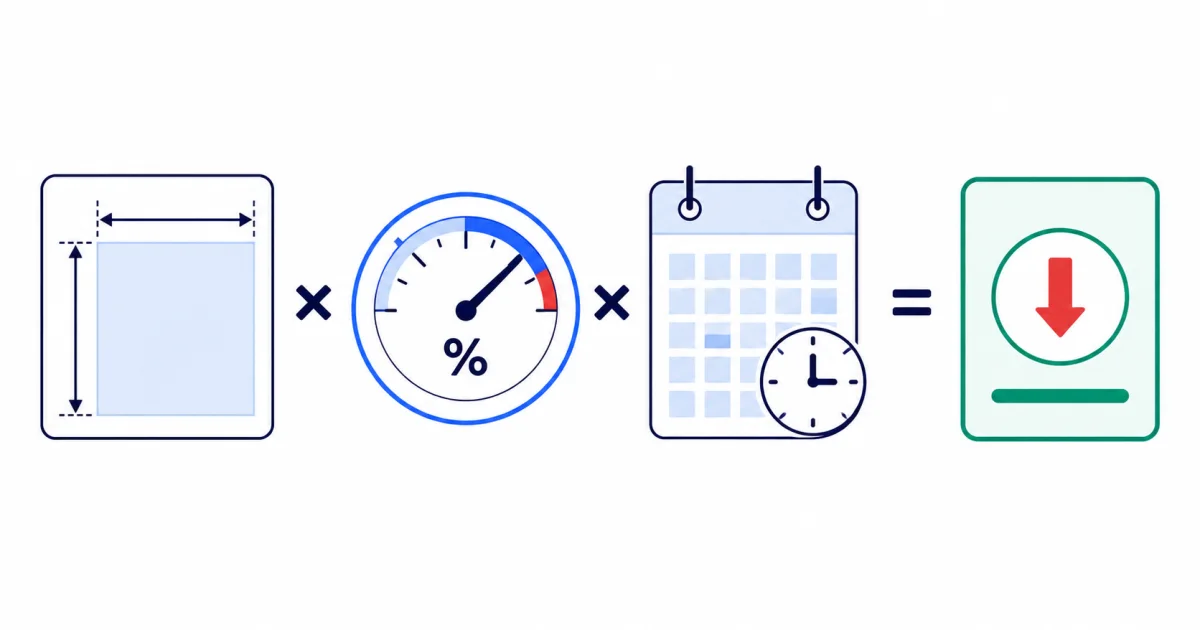
A funding rate becomes useful only after it is converted into money. The calculation itself is short; the mistakes usually come from using your margin instead of the full position value (notional value), assuming the wrong settlement interval, or losing track of which side pays.
The core formula
funding payment = position value × funding rate
For a USDT-margined perpetual, the position value is normally the contract quantity multiplied by the mark price. A $25,000 position at a funding rate of +0.0100% produces a $2.50 payment at that settlement:
$25,000 × 0.0001 = $2.50
If the rate is positive, a long normally pays and a short receives. If the rate is negative, the direction reverses. The magnitude comes from the same formula; the position side determines whether the result is a cost or income.
How to calculate funding over several days
If the rate stayed the same, multiply by the number of settlements the position is open for:
total funding = position value × rate per settlement × number of settlements
Suppose the $25,000 position stays open for seven days and the contract settles every eight hours. That is three settlements a day, or 21 in total. If +0.0100% held for the whole week, a long would pay $52.50 in total.
This is not a forecast. Each future settlement can use a different rate, and the sign can change. For an exact historical total, add the actual payment at each settlement rather than multiplying one current rate.
Worked example: an hourly contract
Hourly contracts use the same arithmetic with a bigger count. Take a $25,000 short on a contract that settles every hour at −0.0050%. A negative rate means shorts pay longs, so the short pays $1.25 at every settlement:
$25,000 × 0.00005 = $1.25 per settlement
$1.25 × 24 settlements = $30 a day
Over the same seven days that is 168 settlements and $210, four times what the eight-hour example cost, even though 0.0050% looks like the smaller number. Count settlements from the interval the exchange shows for that contract, not from habit.
Use the settled rates for an exact total
For a position you have already held, the exact funding is the sum of the rates actually settled while it was open, multiplied by the position value:
total funding = position value × (rate₁ + rate₂ + … + rateₙ)
Strictly, each payment uses the position value at that settlement, which moves with the mark price; for a hold of days rather than months, the opening value is a close approximation. Each contract page lists the settled rates for the last 30 days on every exchange, and the full record can be downloaded as CSV, as the guide to funding rate history explains.
For a position you are still planning, the funding fee calculator works out the cost on every exchange from today's rate and from the 30-day average, which is usually the better guide to a hold of several weeks.
Does leverage change the funding fee?
Leverage does not change the dollar funding payment when the position value stays the same. A $25,000 position pays the same $2.50 at 1x or 10x. Leverage changes the margin supporting it:
initial margin ≈ position value ÷ leverage
funding as % of margin = funding payment ÷ margin
At 10x, approximately $2,500 of margin supports the example position, so a $2.50 payment equals 0.10% of that margin. This is why a small rate can matter to a highly leveraged account.
Settlement intervals and contract types
Do not hard-code an eight-hour interval. Exchanges also use one-, two- and four-hour schedules, and some can shorten the interval during extreme conditions. Inverse contracts may express position value in the underlying asset rather than USDT, so use the exchange's contract specification when you recalculate a payment.
The live funding rate comparison uses each exchange's current settlement interval and converts the rate into what 30 days would cost in dollars, and each contract page adds the last 30 days of recorded rates. To include trading fees and spread, use the futures trading cost calculator.