 vibgg
vibgg
Guides · 5 min read
What is a funding rate, and what does it actually cost you?
Perpetual futures never expire, so funding keeps them tracking spot. How the payment works, who pays whom, and what it costs in dollars.
·
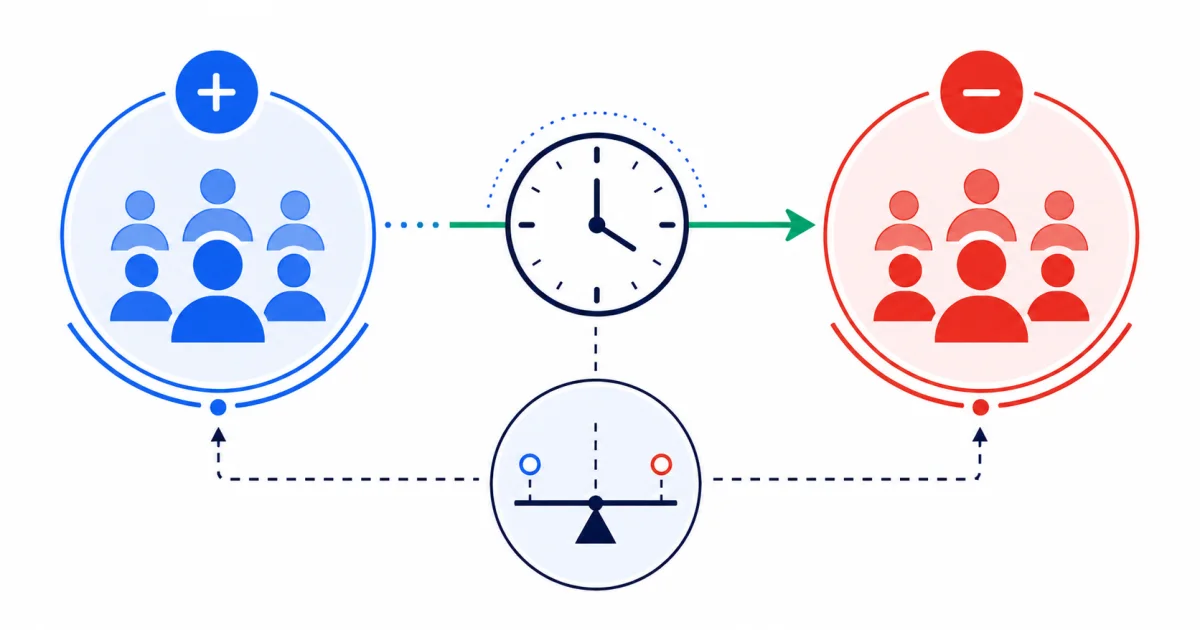
A perpetual futures contract never expires. That is the whole appeal — and it creates a problem the exchange has to solve. A contract with a settlement date is dragged toward the spot price by arbitrage as expiry approaches. A contract with no expiry has no such anchor, so its price can drift away from the underlying and stay there.
Funding is the fix. At scheduled times, open positions pay or receive a small percentage of their position value (the notional value), normally between long and short holders rather than as a fee kept by the exchange. Exactly how the payment is deducted depends on the exchange and your margin mode.
Who pays the funding rate: longs or shorts?
The sign of the funding rate decides the direction:
- Positive rate — long position holders pay short position holders at settlement.
- Negative rate — short position holders pay long position holders at settlement.
The payment helps keep the perpetual aligned with its reference price, but the sign does not prove that the contract is trading above or below spot at this instant. For example, Bybit calculates funding from an interest component and a time-weighted premium index, subject to limits. A positive rate is not itself a bullish signal, nor is a negative rate a recommendation to buy.

How is a funding payment calculated?
Funding is charged on the full position value (the notional value), not on your margin:
payment = position value × funding rate
Worked example, not a live quote: a 10,000 USDT long at a settlement rate of +0.01% pays 1 USDT. A short of the same size receives 1 USDT. If the rate is −0.01%, the payment directions reverse. Bybit's funding calculation specifies the position-value basis and settlement conditions; inverse contracts use a different position-value formula.
Two consequences follow, and both are routinely missed.
Leverage multiplies the pain. A $10,000 position pays the same funding whether you posted $10,000 of margin or $1,000. But at 10x, that payment is ten times larger as a share of the capital you actually put up. This is why funding matters far more to a leveraged trader than the headline percentage suggests.
Only positions open at the settlement time pay. Funding is charged at fixed moments. Every eight hours is common, but one-, two- and four-hour schedules also exist, and some exchanges shorten the interval when a rate reaches its cap or floor. Check the contract's current interval instead of assuming three payments per day.
Why a 0.01% funding rate costs more than it looks
A funding rate of 0.0100% looks like nothing. It is not nothing.
At an eight-hour interval, that rate is applied three times a day, 1,095 times a year. If the rate somehow remained unchanged, the simple annualised figure would be roughly 11% of the position value. It is a scenario, not a forecast: funding resets and can change sign at every settlement.
In that same fixed-rate scenario, a $10,000 position pays $90 over 30 days. At 10x, that is 9% of an initial $1,000 margin balance; over 365 days it would be $1,095, or 109.5%. This arithmetic assumes the position value stays the same through every scheduled settlement, excluding trading fees and price changes. It does not mean a position could remain open for a year without additional margin or liquidation.
This is why vibgg shows every rate as a dollar amount and as a share of margin. The percentage is the input; the money is what you can act on. The funding rate table shows both on every exchange, and each contract page lets you enter your own position size, leverage and holding period.
How to compare funding rates between exchanges
Each exchange sets its own funding rate from its own market. The same contract can have a very different rate on two exchanges at the same moment, and occasionally the sign differs: a position that costs money on one exchange earns money on another.
For a directional position, compare the funding you expect to pay alongside entry and exit fees, the prices you can actually trade at and what your account qualifies for. A lower current rate may reduce one cost component; it does not guarantee a cheaper trade over the full holding period.
Example with two exchanges: suppose exchange A settles at +0.01% and exchange B at +0.03% at the same time, with a $10,000 position on each. A long at A pays $1 while a short at B receives $3, leaving $2 of net funding income for that settlement before costs. The direction is long at the lower rate and short at the higher rate in this particular scenario, not “long wherever funding is positive.”
Different settlement schedules, changing rates, basis moves, execution costs and separate margin balances can reverse the result or liquidate one leg. Read the funding arbitrage risk guide before treating a rate difference you see as a strategy.
None of that is a recommendation to trade. It is an explanation of what the number is and what it costs.
What to check before holding a perpetual position
- The current rate and its sign — are you paying or being paid?
- The settlement interval — the same per-settlement rate costs twice as much per day at four-hour intervals as at eight-hour intervals. Convert both to the same time period before comparing.
- Recent history — check how the rate has moved, rather than treating one reading or a recent streak as a forecast.
- The difference between exchanges — compare the funding amount after allowing for both exchanges' settlement schedules, fees and prices.
The funding rate pages show current rates, settlement intervals and the last 30 days of history. Enter your position size, direction and holding period on a contract page, or follow the step-by-step funding calculation. For an estimate including trading fees and spread, use the futures trading cost calculator; it cannot predict future funding or the prices you will actually get.
Sources
Checked on 27 September 2026 against the Bybit documents below. The numbers in this article are worked examples, not live quotes or trading results. Settlement intervals, rate caps and formulas can differ by contract, so check the exchange's contract details and next funding time before trading.