 vibgg
Guides · 3 min read
Crypto funding settlement times: 1h, 4h and 8h explained
Funding is paid only at set times, and not always every 8 hours. How many contracts settle every 1, 4 or 8 hours on each exchange, and how to count payments.
·
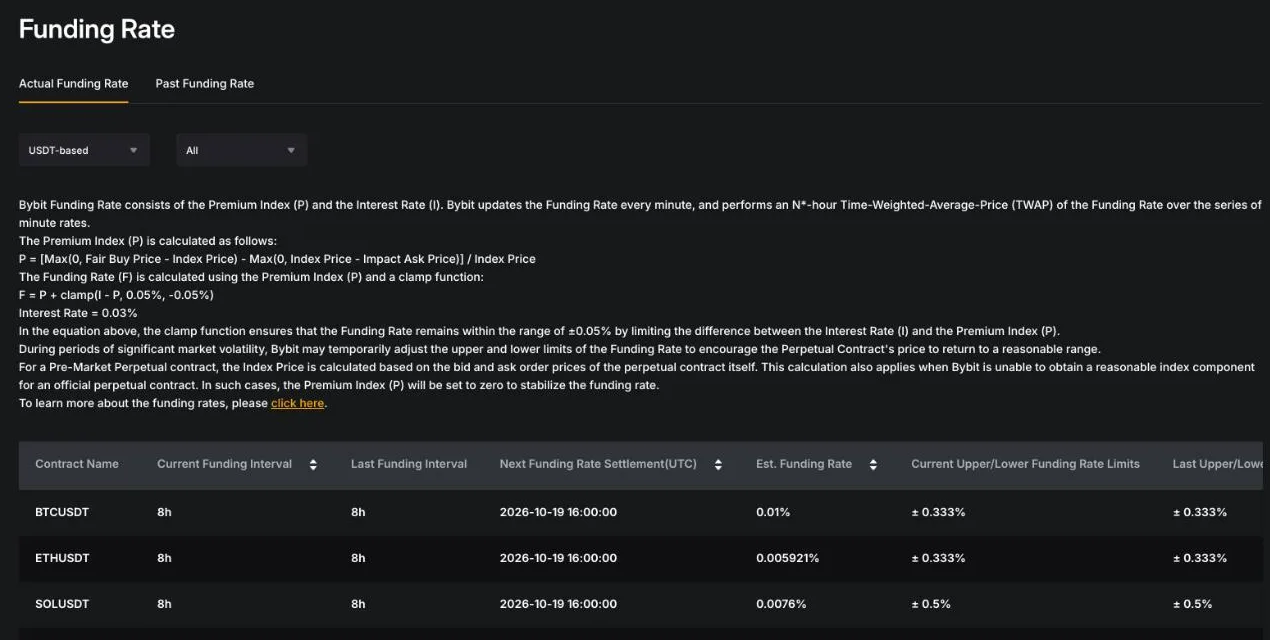
A funding rate without its interval is incomplete. +0.0100% every hour costs eight times as much per day as +0.0100% every eight hours, even though the number shown beside the contract looks identical.
What time is funding paid?
Eight-hour contracts usually settle at 00:00, 08:00 and 16:00 UTC. Four-hour contracts add 04:00, 12:00 and 20:00 UTC. Two-hour and hourly schedules settle correspondingly more often.
Those are the usual times, not a promise for every contract. The exchange's contract details page and the next funding time it shows are what actually apply.
Funding intervals on each exchange right now
Not every contract settles every eight hours. This table counts the perpetual contracts currently listed on each exchange by their settlement interval, and updates with the live data.
| Exchange | Every 8 hours | Every 4 hours | Every 2 hours | Every hour | Contracts |
|---|---|---|---|---|---|
| Binance | 131 | 435 | 0 | 1 | 567 |
| OKX | 285 | 213 | 1 | 0 | 499 |
| Bybit | 422 | 379 | 0 | 3 | 804 |
| Bitget | 467 | 377 | 0 | 1 | 845 |
| Gate | 629 | 415 | 0 | 5 | 1,049 |
The same coin can settle on a different schedule on two exchanges, so compare funding over the same period, such as per day or per 30 days, rather than rate against rate. Each contract page does that conversion and shows the next settlement time on every exchange.
How to count settlements
A position pays or receives funding when it is open at a settlement time, not because it was open for a certain number of hours. A position opened just after 08:00 UTC and closed before 16:00 UTC on an eight-hour contract normally pays no funding. The same position closed just after 16:00 UTC pays once.
When planning a trade, count the actual settlement times inside your holding period. Multiplying “days × 3” only works for a contract that settles every eight hours and a position that stays open through every settlement.
How the interval changes the cost
The interval multiplies the rate. At the default of 0.03% a day, an eight-hour contract charges 0.0100% three times and a four-hour contract 0.0050% six times: the same daily cost. When the rates differ, convert both to a daily figure before comparing:
daily rate = rate per settlement × 24 ÷ interval in hours
+0.0080% every four hours is 0.048% a day; +0.0150% every eight hours is 0.045% a day. The four-hour contract is the more expensive one despite showing the smaller number. The funding fee calculator does this conversion for every exchange at once, and the guide to the 0.01% default explains why the default per settlement shrinks with the interval.
Intervals can change
Some exchanges shorten the settlement interval automatically when funding reaches its cap or floor. OKX describes moving eligible perpetuals between eight-, four-, two- and one-hour schedules, and Binance and Bybit also describe cases where a contract switches to hourly settlement.
After such a switch the rate is recalculated for the new schedule, so the same rate is not simply charged more often. But an out-of-date assumption about the interval can badly misstate what a position costs.
Do not rely on last-second timing
Do not count on opening or closing in the last seconds around a settlement to avoid a payment. Exchanges need time to process each settlement, and Bybit warns that activity within five seconds before or after the funding time is not guaranteed to be included or excluded.
The vibgg funding rate table shows each exchange's current settlement interval, and every contract page lists the next settlement time. Use the time shown by the exchange when you trade, and vibgg's figures to compare exchanges on the same footing.