 vibgg
vibgg
Guides · 3 min read
What 10x leverage actually costs to hold for a month
Leverage does not change what you pay in dollars. It changes what that payment is as a share of your own capital — and that is where positions quietly die.
·
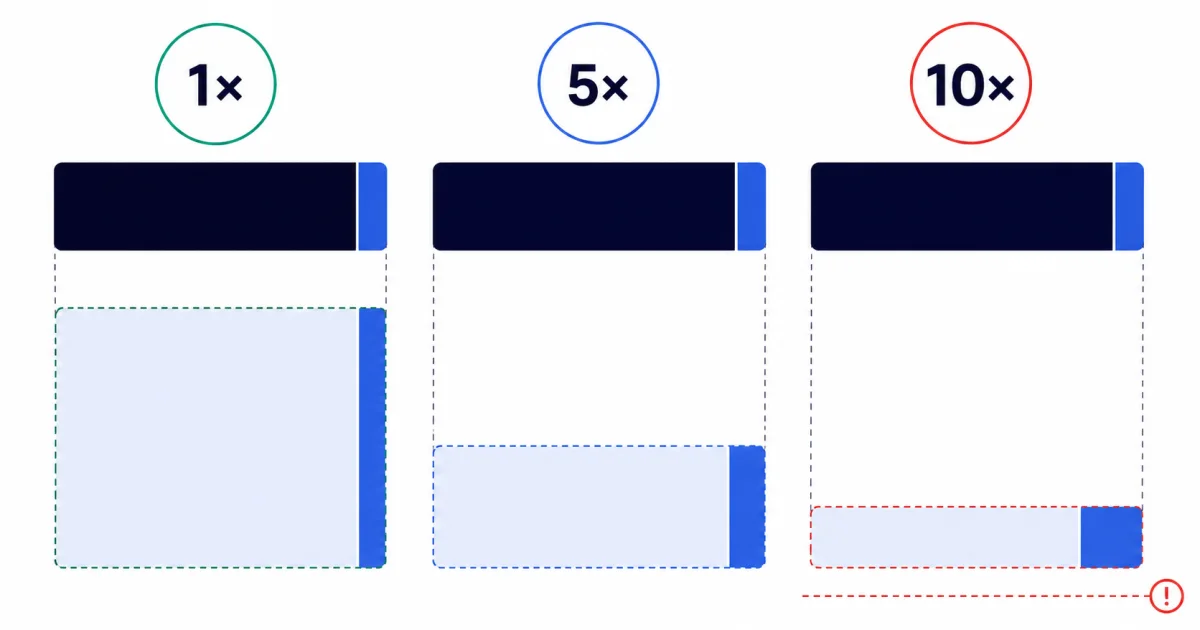
Most explanations of leverage stop at liquidation. Liquidation is the obvious risk and the one everybody plans for. The one that drains accounts quietly is the holding cost: the funding you pay simply to keep a leveraged position open, charged every few hours whether or not the price moves at all.
How leverage changes the cost of funding
Funding and trading fees are charged on the full position value. Leverage does not change them:
$10,000 position at 1x  → margin $10,000
$10,000 position at 10x → margin $1,000
both pay the same funding
What changes is the denominator you should be measuring against. The same dollar cost is 10x larger as a fraction of the capital you actually put up.
Take a hypothetical funding rate of 0.01% per eight hours. This is an arithmetic example, not an estimate of what the next rate will be.
- Three settlements a day × 30 days = 90 settlements
- 90 × 0.01% = 0.9% of the position value per month
- At 1x, that is 0.9% of your capital
- At 10x, it is 9% of your capital
- At 25x, it is 22.5%
At 25x, an ordinary funding rate consumes roughly a fifth of your margin per month before the price has done anything at all. The position does not need to be wrong to lose money. It only needs to be open.
Why this is easy to miss
Funding is deducted in small pieces at fixed times, and it appears in an exchange's interface as a percentage of the position value — a number that looks small. Nothing in the trading screen presents it as a share of the margin that is actually at risk, which is the only frame in which the size of it is obvious.
It is also silent. A 9% drawdown from price movement is visible and gets attention. A 9% drawdown from ninety small deductions gets read as normal.
What to do about it
Check funding before opening, not after. The rate is published in advance of each settlement. If the funding over your intended holding period is a meaningful share of your margin, that changes the trade before you place it.
Compare exchanges. Each exchange sets its own rate. On the same contract at the same moment the gap between exchanges can be large, and the dollar difference grows with position size and every settlement crossed. Use the current comparison rather than a fixed historical rule of thumb.
Consider the other side. When funding is persistently positive, shorts are being paid. That is not a reason to be short — direction is a separate decision — but it is why funding rate arbitrage exists, and why crowded longs pay for it.
Match leverage to holding period. High leverage over minutes is a liquidation-risk question. High leverage over weeks is a holding-cost question, and that cost grows against your margin in proportion to the leverage.
Run it on the position you are actually considering
Every contract page on vibgg takes a position size, a leverage multiple, a holding period and a direction, and returns the funding cost in dollars and as a share of margin on each exchange, cheapest first, with the last 30 days of recorded rates underneath. The funding pages are the entry point; BTC-USDT is a reasonable place to start.
The estimate assumes today's rate stays the same, which it will not — funding is reset at every settlement and tends to drift back toward normal. Treat it as today's holding cost, not a forecast.
Sources
This article repeats one funding rate across a month to show the arithmetic; it does not predict future rates. Bybit and OKX both note that funding deductions can reduce available or position margin and increase liquidation risk in some margin modes.