 vibgg
vibgg
Guides · 4 min read
How perpetual futures trading fees actually work
Maker, taker, VIP tiers, token discounts and referral rebates — what each one is, how they combine, and how to work out the rate you are really paying.
·
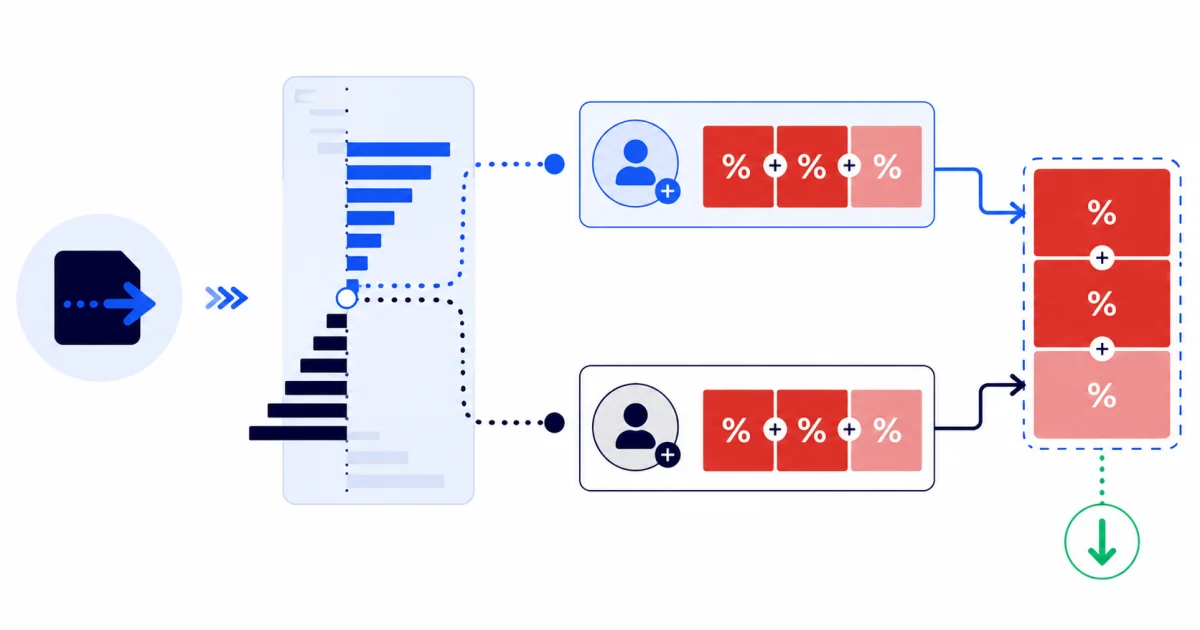
The fee you pay to trade a perpetual contract is not one number. It is four, stacked, and only the first is printed on the exchange's front page.
Maker and taker
Every fill is one or the other.
A taker order removes liquidity: it matches immediately against an order already resting on the book. Every market order is a taker trade, and so is a limit order priced aggressively enough to cross the spread on arrival.
A maker order adds liquidity: it rests on the book and waits. Exchanges charge makers less — sometimes nothing, and at the top VIP levels on some exchanges a maker is paid a rebate — because resting orders are what makes the market tradeable.
On the major exchanges the entry-level maker fee for perpetual futures is often around 0.02%, while the taker fee usually sits around 0.05–0.06%. The exact rate varies by exchange, product and region. Today's standard VIP 0 fees, from each exchange's official fee page:
The fee page inside your own account is always the final word on the rate you pay.
Note what that implies. Moving even part of your trading from market orders to resting limit orders is usually the single largest fee reduction available to a retail trader, and it costs nothing but patience and some fill risk.
VIP levels and trading volume
Exchanges discount fees as 30-day volume rises, in bands usually labelled VIP levels. Two details matter more than the headline table.
The volume that counts is total trading volume, not profit. Opening and closing trades both count. A trader turning over the same $50,000 of capital ten times a month generates $1,000,000 of qualifying volume, not $50,000.
Spot and futures ladders are separate. The qualifying volume, balance requirements and region-specific rates can differ by product. A tier shown on a spot fee page should not be assumed to apply to perpetuals; check the futures column and the fee page attached to the account you will actually trade from.
Some exchanges also accept an asset balance as another route to a VIP level: hold enough on the exchange and you get the discount without the volume. Whether that is worth it depends on what the capital would otherwise earn — and on your view of exchange custody risk, which is not a fee question.
Each exchange's full VIP fee schedule is on the futures fee comparison pages.
Platform token discounts
Some exchanges cut fees or alter tier qualification when you hold or use the platform's own token. The size, eligible product and availability of the discount change over time and by region, but the trade-off is stable: receiving the discount can require holding a volatile asset you did not otherwise want.
Treat it as what it is. A 20% fee discount funded by holding a token that can fall 40% is not a 20% saving; it is a fee discount plus an unhedged position. vibgg's comparisons use the standard published fee rather than the token-discounted one, so every exchange is compared the same way.
Referral fee discounts
The fourth layer is referral pricing. Some affiliate programmes return a share of eligible fees to the referrer, and some referrers pass part of that share back to the user. Eligibility, duration and the products covered vary, so the rebate shown at signup must be checked against the programme terms rather than assumed to last forever.
Two things determine whether it is worth anything: the affiliate's commission tier, and how much of it they return. A rebate is also only ever available at signup — most programmes attribute on the first registration, so an existing account generally cannot be retrofitted.
To be clear about our own: vibgg's exchange links are referral links. Where a discount applies, the calculator says so and lets you switch it off to compare standard fees.
How to calculate the fee you really pay
The rate you actually pay is:
effective fee = your VIP level's rate
              × (1 − token discount)
              × (1 − referral rebate)
              blended across your maker/taker split
Worked through: a trader doing $2,000,000 of monthly volume, 80% as taker, at an entry level of 0.02% maker and 0.05% taker, pays a blended 0.044% — $880 a month, $10,560 a year. A 20% referral discount takes that to $8,448. Shifting from 80% to 50% taker, with no discount, brings it to $8,400 on its own; doing both takes it to $6,720.
Fees are also not the whole cost. Funding and the spread you cross are frequently larger than the commission, especially for anyone holding positions rather than scalping them. The futures trading cost calculator adds all three together and ranks exchanges by the total.
Sources
Fee schedules change. The examples above were checked on 3 September 2026 against the exchanges' own documentation, and the table updates whenever a fee level is re-checked. The fee shown inside your own account is what applies.