 vibgg
vibgg
Guides · 4 min read
Positive vs negative funding rates: who pays whom?
A positive rate is a cost to longs and income to shorts; a negative rate reverses the flow. Here is how to read the sign without treating it as a price prediction.
·
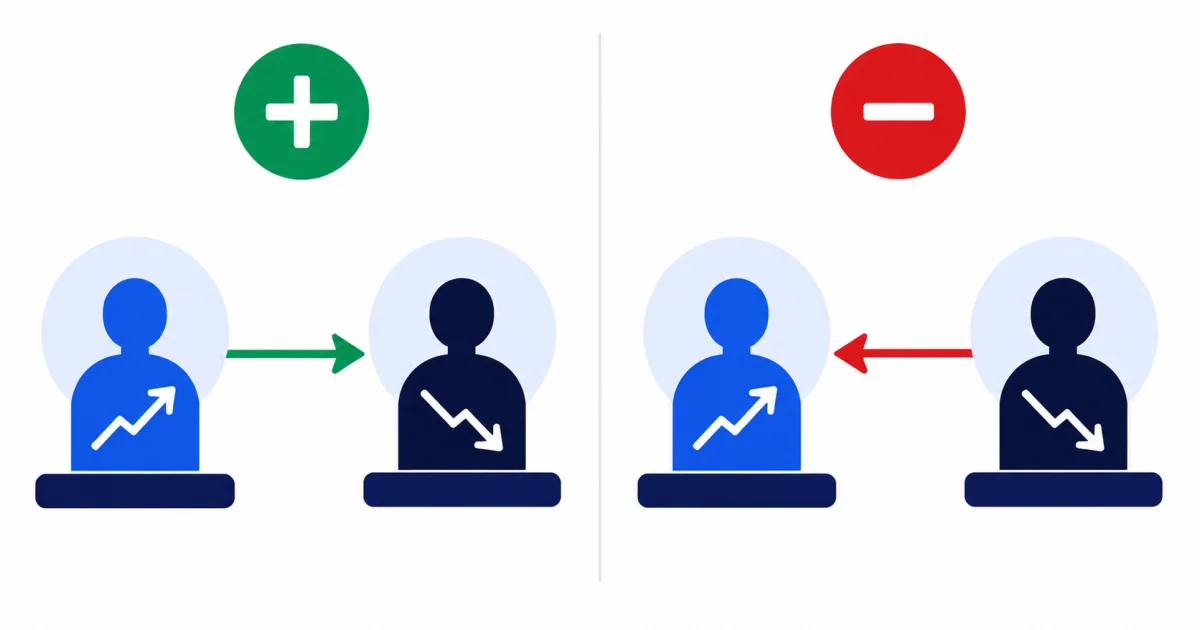
The sign of a perpetual funding rate describes a payment direction. It does not, by itself, tell you whether the next price move will be up or down.
How many funding rates are positive right now?
Across the 2,719 perpetual contracts on vibgg with a non-zero rate, 84.81% are currently positive — longs paying shorts. That lopsidedness is the normal state of a market where most participants want leveraged upside, and it is the reason a persistently negative contract is worth a second look rather than a shrug.
What a positive funding rate means
When funding is positive, long positions normally pay short positions at settlement. Positive funding often appears when the perpetual trades above its underlying spot index and demand for leveraged long exposure is stronger.
For a $10,000 long at +0.0120%, the next settlement costs $1.20. A short of the same size would normally receive the same amount, subject to the exchange's settlement rules.
What a negative funding rate means
When funding is negative, short positions normally pay long positions. A $10,000 long at −0.0120% would therefore have a $1.20 funding receipt at that settlement, while the equivalent short would pay.
Negative funding does not make a long position safe. A favourable funding payment can be much smaller than an adverse price move, trading fee or spread. Funding is one cash flow inside the position, not protection from market risk.
What makes a funding rate turn negative?
On the formula Binance, Bybit and OKX publish, funding sits at a positive default of 0.01% per eight hours while the perpetual trades close to its index. It only drops below that when the perpetual trades at a discount large enough to pull the average premium under about −0.04% per eight hours, and it turns negative only when the discount goes past about −0.05%.
That is why negative rates are the minority: it takes sustained selling pressure on the perpetual, not just a quiet market. The guide to the 0.01% default walks through the formula with worked numbers.
What the sign can and cannot tell you
The sign is evidence about the current relationship between the perpetual market and its reference price. A rate that stays positive means holding a long is expensive; a rate that stays negative means holding a short is expensive. Neither condition is a standalone reversal signal.
The useful questions are more concrete:
- Which side of the proposed position will pay?
- How large is the payment in dollars?
- How many settlements does the planned holding period cross?
- Is the sign the same on every exchange, or only on one?
Why exchanges can show different signs
Each exchange calculates funding from its own perpetual market with its own method. In fast markets, BTC-USDT can have positive funding on one exchange and negative funding on another. That can make one exchange cheaper for a directional position, but moving between exchanges adds trading, collateral and counterparty risk.
Use the funding rate table across exchanges to compare signs and settlement intervals at the same moment. Each contract page also turns every rate into the cost or income for the side you choose, and shows how often the rate was positive over the last 30 days.
How long do negative rates last?
There is no rule. A negative rate can last one settlement after a sharp sell-off, or weeks on a contract that traders keep shorting. Before treating negative funding as income for a long, look at its history: each contract page shows how many of the last 30 days' settlements were positive on each exchange, and how many settlements in a row the current sign has held.
The funding rate rankings list the contracts with the most negative rates averaged across exchanges right now. A contract that has been negative for one settlement is a very different proposition from one that has been negative for three weeks.